Get Weekly Travel Inspiration Straight to Your Inbox




100+ subscribers
Join 100+ subscribers who receive our curated destination picks, flight deal alerts, and exclusive travel guides — every Thursday.

Your insider guide to Krakow’s Old Town, the Wieliczka Salt Mine, the Dragon of Wawel, and everything in between.
If you’ve been told that Krakow, Poland is “the next Prague,” believe it. In fact, many travellers who’ve done both say Krakow wins. Spared from the heavy bombing that levelled Warsaw and so many other European cities during WWII, Krakow stands as one of the continent’s most beautifully preserved medieval cities. Gothic spires, Renaissance courtyards, Baroque facades, buzzing student bars, extraordinary food — and a price tag that makes Western Europe blush.
It’s a city that layers its history honestly. You get the royal grandeur of Wawel Hill alongside the sobering gravity of its wartime past. You get legends of fire-breathing dragons and dimly lit jazz caves. You get pierogies so good you’ll lose count of how many you’ve eaten. And just 15 kilometres away, one of the most extraordinary underground worlds on the planet: the Wieliczka Salt Mine.
Simply put, Krakow, Poland punches well above its weight.
Krakow has a humid continental climate, and each season offers a genuinely different experience:
Spring (April–June) is the sweet spot for most visitors. The weather is mild, the Planty Park ring of gardens surrounding the Old Town is in full bloom, and prices are noticeably lower than summer. You can walk for hours without the July heat and without fighting peak-season crowds. This is the window most experienced travellers recommend.
Summer (July–August) is peak season and comes with peak energy. Outdoor café terraces fill up, the Dragon Parade festival lights up the city, and the pagan holiday Wianki brings locals and visitors to the banks of the Vistula River. The Tatry Mountains to the south are fully accessible for hiking. Just be aware: this is when crowds are heaviest and accommodation prices climb accordingly.
Autumn (September–October) is a strong runner-up. The weather remains pleasant early in the season, the city’s parks turn spectacular shades of gold and copper, and the tourist rush thins out. A favourite among photographers and those who prefer a slower pace.
Winter (November–March) is cold, sometimes snowy, but has its own magic — especially in December when the Christmas Market transforms the Main Market Square into a fairy-tale scene. Fewer queues at the salt mine, better hotel deals, and a cozy, candlelit atmosphere in the city’s underground bars. Pack layers.
Quick verdict: April to June or September to October for the best balance of weather, crowds, and price. December if you love Christmas markets.
By Air
Krakow is served by John Paul II International Airport (KRK), located just 15 km from the city centre. It’s a modern, well-connected hub with direct routes to roughly 100 cities across more than 30 countries. Budget airlines including Ryanair, Wizzair, and EasyJet connect Krakow with most major European cities, often at very competitive prices. Book early — Easter and summer slots can sell out months in advance.
Getting from the airport to the centre is straightforward: trains depart twice per hour and reach Krakow Główny station in just 17 minutes.
By Train
Krakow Główny railway station sits right beside the Old Town — you step off the train and you’re already there. Poland has solid rail connections with neighbouring countries, including Czech Republic, Slovakia, Austria, Germany, and Hungary. The overnight EuroNight Carpatia sleeper to Munich is a fan favourite, letting you wake up refreshed in a new country having saved a night’s accommodation.
By Bus
Coaches are the budget option. FlixBus, Sindbad, Eurolines, and RegioJet all serve Krakow with routes to nearly 175 cities across Central Europe, France, Italy, and beyond. Journey times vary: Vienna is roughly 5–6 hours, Berlin around 8–9 hours, and Prague around 7 hours. Not glamorous, but affordable and convenient.
From Within Poland
Warsaw to Krakow by express train takes just 2.5 hours and runs frequently throughout the day — a very easy connection.
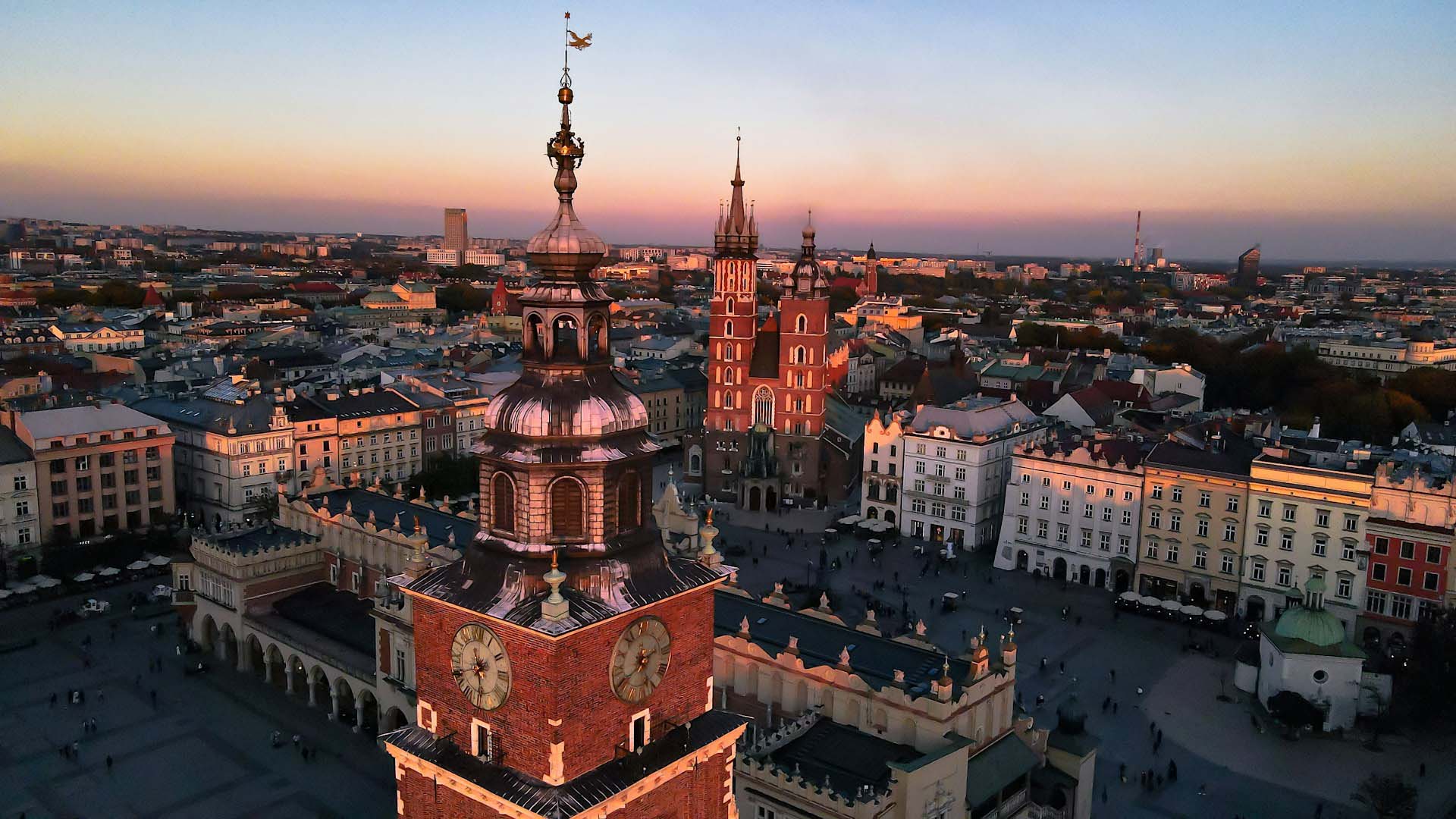
The heart of Krakow Old Town is the Rynek Główny — one of Europe’s largest and most beautiful medieval market squares. It’s the centrepiece of a district that has been a UNESCO World Heritage Site since 1978, and it earns that status every single day. At the square’s centre stands the Cloth Hall (Sukiennice), a 14th-century trading arcade now filled with amber jewellery, folk crafts, and souvenir stalls. Walk the perimeter and you’ll pass palaces, cafés spilling onto cobblestones, horse-drawn carriages, and the soaring towers of St. Mary’s Basilica — one of Poland’s most iconic Gothic churches. Every hour, a trumpeter plays the hejnał from the taller tower, a tradition dating back to the Middle Ages.
The Old Town is compact and entirely walkable, encircled by the lush Planty Park that replaced the old city walls in the 19th century. Allow a full half-day here at minimum, more if you linger at the cafés.
Suggested time: 3–4 hours minimum.
Perched dramatically on Wawel Hill above the Vistula River, Wawel Castle was the royal seat of Polish rulers for five centuries, from 1038 to 1596. It’s one of the most impressive castle complexes in all of Europe, with Renaissance courtyards, royal apartments, a treasury, armoury, and the magnificent Wawel Cathedral where Polish kings were crowned and buried.
Much of the castle grounds are free to explore — simply wandering the courtyard and taking in the views over the river is worth the short walk from the Old Town. Paid tickets unlock the interior exhibitions and are available at the castle ticket office.
But no visit to Wawel is complete without hunting down the Dragon Krakow has made famous. According to Polish legend, a fire-breathing beast called Smok Wawelski once terrorised the city from a cave beneath the hill, devouring livestock and demanding tribute, until a clever shoemaker named Skuba tricked it into eating a sheep stuffed with sulphur. The dragon rushed to the Vistula River and drank so desperately to quench its burning stomach that it eventually exploded, saving Krakow for good.
Today the legend lives on in two unmissable ways. First, you can descend into the Dragon’s Den (Smocza Jama) — a cave reached by 130 steps, opening onto the riverbank at the base of Wawel Hill. The ticket costs 10–20 PLN and the experience is brief but atmospheric. Second, right outside the cave exit stands the famous Wawel Dragon statue sculpted by Bronisław Chromy in 1969. Every five to seven minutes, it breathes real fire — no warning, no fanfare, just a sudden jet of flame that genuinely startles first-timers. Children love it. Adults pretend they didn’t flinch. Viewing the statue on the riverbank is completely free and accessible around the clock.
The dragon bones hanging near the entrance of Wawel Cathedral — said to keep the cathedral standing so long as they hang in place — are worth seeking out too. They’re actually the remains of prehistoric mammals, but the legend is far more satisfying.
Suggested time: 2–4 hours for Wawel Castle and Dragon’s Den combined.
A short walk south of the Old Town, Kazimierz is Krakow’s most layered and evocative neighbourhood. Once the centre of Jewish life in southern Poland, it carries the memory of a community largely destroyed during the Holocaust while also buzzing with contemporary energy: vintage cafés, independent galleries, craft cocktail bars, and street food vendors fill its cobbled lanes.
Visit the Old Synagogue (the oldest surviving synagogue in Poland, now a museum), the active Remuh Synagogue and its atmospheric cemetery, and wander without a plan — Kazimierz rewards the unhurried. The neighbourhood was also a location for Steven Spielberg’s Schindler’s List, and its worn facades feel immediately recognisable to anyone who’s seen the film.
Suggested time: 2–3 hours wandering; half a day if you include a guided tour.
Located in the Podgórze district just across the river from Kazimierz, Oskar Schindler’s Enamel Factory is now one of Krakow’s most important museums. The exhibition Kraków under Nazi Occupation 1939–1945 is not just a museum — it’s a carefully constructed immersive experience that tells the story of what happened to the city and its Jewish residents during the war. Powerful and sobering; it’s the kind of place that stays with you. Book tickets in advance as queues can be long.
No guide to Krakow, Poland would be complete without the Wieliczka Salt Mine — and no trip to the city should skip it. Located just 15 kilometres southeast of Krakow, this UNESCO World Heritage Site is one of the most visited attractions in all of Poland, and it genuinely lives up to the hype.
The mine has been active since the 13th century, making it one of the world’s oldest continuously operating industrial sites. Salt mining officially ended here in 1996, but the legacy is staggering: over 300 kilometres of tunnels on nine levels, descending to a depth of 327 metres. The Tourist Route takes you through the most spectacular 3.5 kilometres of that underground world, ending with a lift ride back to the surface.
What makes the Wieliczka Salt Mine unforgettable is its art. Generations of miners carved elaborate sculptures, bas-reliefs, and entire chapels out of the salt rock. The crown jewel is the Chapel of St. Kinga, an ornate underground cathedral with chandeliers made entirely of salt crystal, altarpieces carved from salt, and a floor that crunches under your feet. It hosts weddings, concerts, and religious services to this day. Walking into it is one of those proper jaw-dropping travel moments.
Beyond the chapel, you’ll encounter underground lakes, intricate timber mining structures, and chamber after chamber of handmade salt sculptures — from dwarves to a recreation of Leonardo da Vinci’s Last Supper.
Practical details:
Suggested time: Half a day including travel from Krakow.
Krakow Old Town is entirely walkable — most of the major attractions sit within a 20-minute stroll of the Main Market Square. For longer distances, the city has a reliable tram and bus network. Taxis and Bolt (the ride-hailing app widely used in Poland) are affordable by Western European standards. For a scenic way to get between the Old Town and Wawel Hill, some visitors rent electric scooters, which are available throughout the city.
Real feedback from the travel community paints a vivid picture:
“Krakow is one of my favourite places in Europe. My first view of the Main Square was jaw-dropping.” — Fodor’s community member
“Been living in and exploring Krakow for nearly 2 years, my favourite city so far. Love everything about it: it’s cosy, green, walkable and simply beautiful.” — Local resident, Wanderlog community
“The salt mine at Wieliczka is a must-visit — children will enjoy it. And eating out is easy and cheap; children are welcome everywhere.” — Fodors.com community member
“I visited the Wieliczka Salt Mine on December 28th and the experience was captivating from start to finish. Despite the Christmas season and the high attendance, the organisation was very efficient and the visit went smoothly without excessive waiting.” — Trip.com verified reviewer
“The Polish donuts at Gorące Pączki are the bomb. Would also recommend going to the Salt Mine.” — Wanderlog community
A recurring theme across travellers’ accounts: surprise at how much value Krakow offers, and frustration at having not come sooner. The city consistently earns praise for its walkability, its food scene, and the sheer density of things worth seeing.
Book the Salt Mine in advance. Online tickets for the Wieliczka Salt Mine sell out quickly in summer, and walk-up queues can be brutal. Book at least a week ahead during peak season.
The Krakow Dragon statue is free — and better at night. The fire-breathing sculpture by the Vistula is accessible 24/7 at no cost. In the evening, with the glow of the flames reflected in the river and Wawel Castle lit up above, it’s genuinely spectacular.
Eat well and spend little. Traditional Polish food in Krakow is excellent and extremely affordable. Look for a bar mleczny (milk bar) — these no-frills canteens serve hearty, home-cooked Polish food for almost nothing. Don’t leave without trying pierogies in multiple fillings, żurek (sour rye soup), and at least one paczek (Polish doughnut).
Take a free walking tour. Several companies run tip-based walking tours of the Old Town and Kazimierz. They’re a fantastic way to absorb the city’s history and get your bearings before exploring independently.
Visit Wawel Hill early. The castle grounds open early, and the first hour after opening is significantly quieter. The light on the castle is also beautiful in the morning.
Download the Bolt app before you arrive. Ride-hailing in Krakow is cheap, reliable, and much more transparent than flagging down a street taxi.
Two to three days is a solid minimum. One day for the Old Town and Wawel. One for Kazimierz and Schindler’s Factory. One full morning for the Wieliczka Salt Mine.
Learn a few words of Polish. Dziękuję (DYEN-koo-yeh) means thank you. Locals genuinely appreciate the effort.
| Duration | What You Can Cover |
|---|---|
| 1 day | Krakow Old Town, Wawel Castle, Dragon Statue |
| 2 days | Add Kazimierz, Schindler’s Factory, evening food tour |
| 3 days | Add the Wieliczka Salt Mine as a half-day trip |
| 4–5 days | Add Auschwitz-Birkenau Memorial, day trips to Zakopane in the Tatry Mountains |
Krakow, Poland rewards every kind of traveller — the history buff, the foodie, the legend-hunter, the festival-goer, and the person who just wants to sit in a beautiful square and watch the world go by. Go. You’ll understand why people keep coming back.